

| Standard NEMT (sedan/SUV) | Ambulette (wheelchair van) | |
|---|---|---|
| Passenger mobility | Can walk or transfer into a car seat | Stays seated in their wheelchair |
| Vehicle | Sedan or SUV | Van with hydraulic lift or ramp + wheelchair securements |
| Door-through-door help | ✓ Driver assists to and from the door | ✓ Driver assists and secures the wheelchair |
| Typical riders | Ambulatory seniors, dialysis, follow-up visits | Wheelchair users, limited weight-bearing, bariatric needs |
| Coverage | Medicaid (MAS), Medicare Advantage, private pay | Medicaid (MAS) — may require ambulette authorization |
| When booking | Request standard NEMT | Specify wheelchair / ambulette so the right vehicle is sent |
What is NEMT?
Non-Emergency Medical Transportation describes the entire category of scheduled, non-emergency, ground-based medical transport. It includes everything from a sedan picking up a senior for a doctor visit to a wheelchair-accessible van transporting a dialysis patient to a stretcher transport moving a bedridden patient.
What is an ambulette?
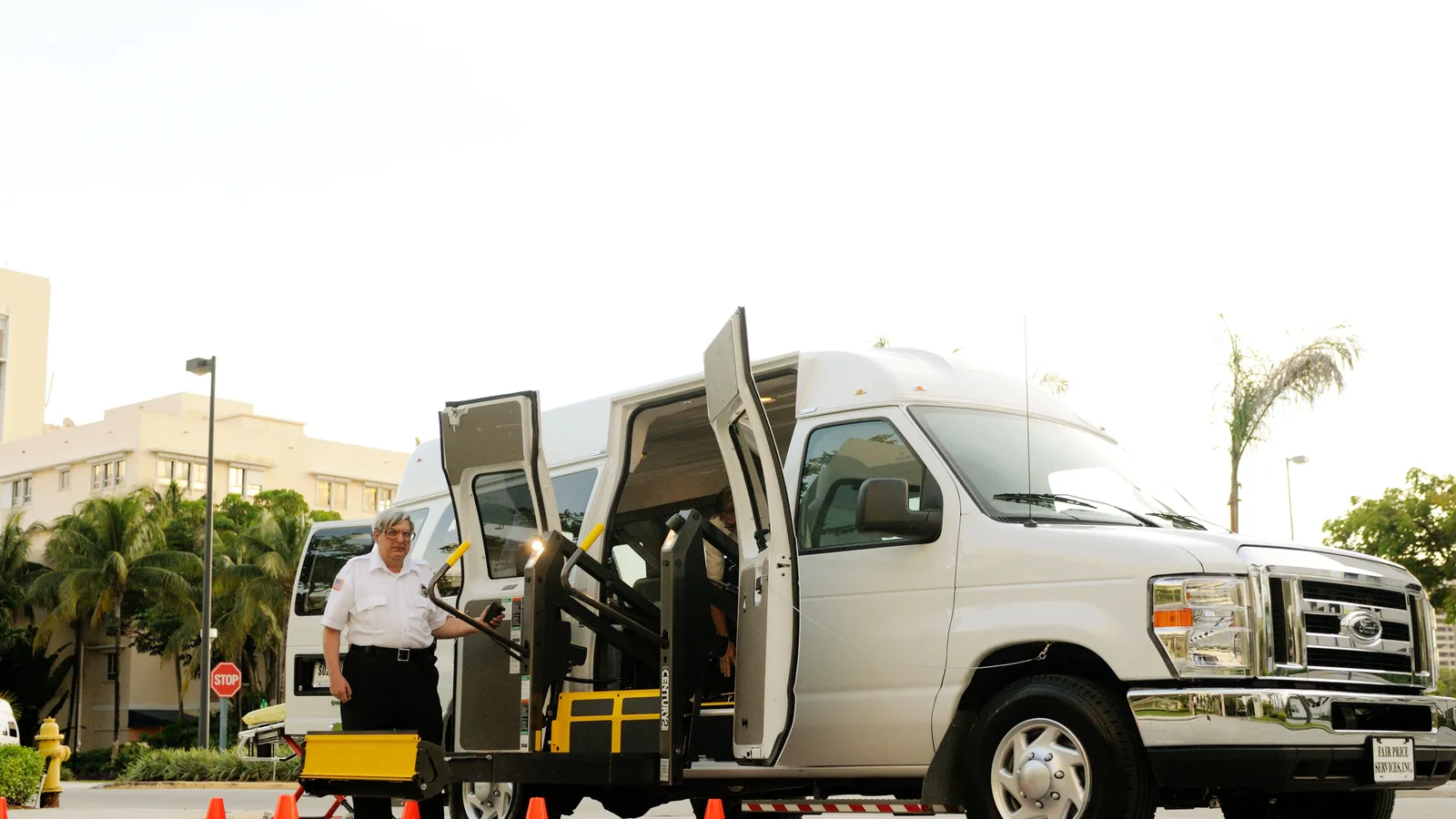
An ambulette is a wheelchair-accessible van staffed by a trained driver-attendant. It has a hydraulic lift or ramp, four-point wheelchair securement, and seating for ambulatory passengers and companions. Ambulettes are used for NEMT trips where the passenger needs accessibility (wheelchair) and door-through-door assistance but does not need medical monitoring.
Which do I need — NEMT or an ambulette?
- Ambulatory passenger, no mobility device: Standard NEMT sedan or wagon.
- Wheelchair user or significant mobility limitation: Ambulette.
- Cannot sit up, must lie flat: Stretcher transport (a different vehicle).
- Medical emergency or needs monitoring en route: Ambulance, not NEMT.
How do NEMT and ambulette prices compare?
Ambulette trips typically cost more than ambulatory NEMT trips, because the vehicle is more specialized and loading/securement takes more time. Medicaid pays a higher rate for ambulette trips; private-pay rates are also higher — see our pricing.
"Ambulette" is a New York term, which is why the comparison confuses people
Part of the difficulty in comparing the two is that they are not the same kind of word. NEMT is a benefit category — the thing Medicaid covers — while ambulette, in New York, is a regulated vehicle and service classification with its own licensing and standards. Much of the country simply says "wheelchair van" for the same vehicle, so guidance written elsewhere will not use the term at all, and searching for it turns up New York and New Jersey sources almost exclusively. If you have moved to Long Island from another state, this is usually the source of the confusion: the vehicle is familiar, the vocabulary is not.
The practical consequence is that ambulette is a level of service within NEMT, not an alternative to it. A Medicaid trip authorised at ambulette level is still an NEMT trip; the classification tells the broker what kind of vehicle and what kind of assistance to send.
The real difference is the assistance, not just the vehicle
Focusing on the ramp or lift misses what actually separates the two tiers. An ambulette is staffed by a driver-attendant whose role includes hands-on help: assisting you from the door of your home to the vehicle, positioning and securing the chair with a four-point tie-down, and handing you over at the destination entrance rather than the kerb. That is what "door-through-door" means, and it is a service standard rather than a courtesy.
Ambulatory NEMT is a different arrangement. The driver will help you into the vehicle and will not drive off while you are still finding the door, but the trip assumes you can walk and manage the journey largely unaided. For someone who uses a walker, is unsteady after a procedure, or cannot manage a kerb alone, that gap matters more than the vehicle type does — and it is the reason to describe your mobility honestly at booking rather than choosing on the basis of which vehicle sounds less medical.
Being assigned the wrong level is a fixable problem
If a sedan arrives for a wheelchair user, or an ambulette for someone who could have travelled ambulatory, the cause is almost always the mobility information recorded when the trip was booked, not a dispatch failure. Call MAS at 1-844-666-6270 with your confirmation number and ask for the level of service to be corrected on the authorisation — otherwise the same mismatch repeats on every future trip, including the return leg of the one you are on. Where a trip genuinely needs clinical monitoring en route rather than mobility assistance, neither tier is appropriate and the answer is an ambulance.