

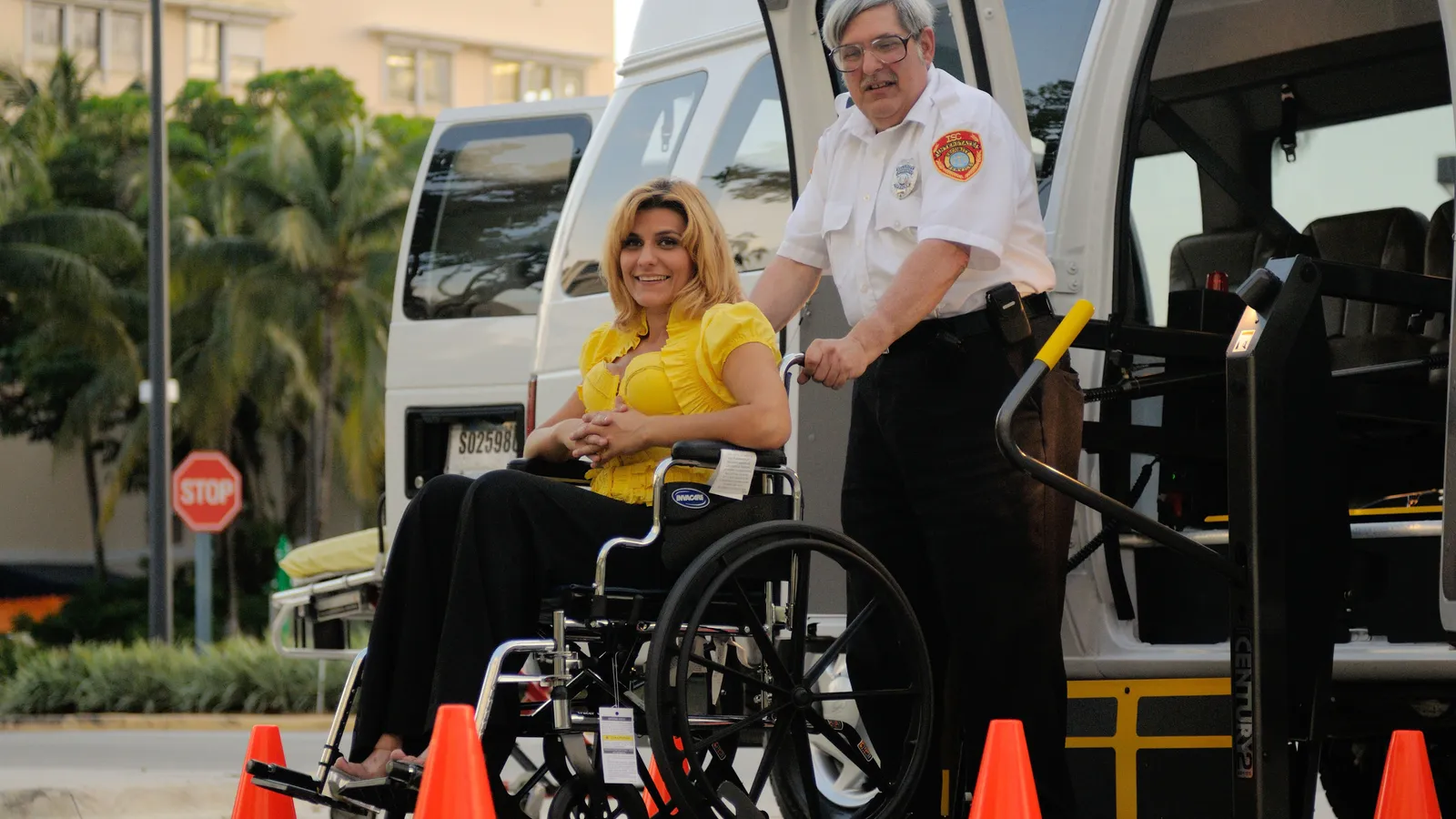
- Wheelchair-accessible van
- Lift / ramp
- Stay seated in your wheelchair
- Safety securements
- Secured
- 4-point tie-downs + lap/shoulder belt
- With Medicaid
- $0
- May require ambulette authorization
- Driver assistance
- Door-through-door
- Loaded and unloaded safely
What is an ambulette?
An ambulette is a wheelchair-accessible van equipped with a hydraulic lift or ramp, floor-track securement systems, and tie-down straps that hold the wheelchair in place during transit. The passenger never leaves their wheelchair: they board, the chair is secured, and they ride to their destination seated in their own chair.
Ambulettes are staffed by trained drivers (sometimes called ambulette attendants) who are certified in wheelchair securement and passenger assistance. In New York State, ambulette vehicles are regulated by the NYS Department of Transportation (NYSDOT), and ambulette companies must meet its licensing, inspection and operating rules. For a Medicaid trip, the van must pass NYSDOT inspection twice a year and the driver must be certified under Article 19-A of the Vehicle and Traffic Law, according to the eMedNY Medicaid Transportation Policy Manual and the April 2022 NYS Medicaid Update. The ambulette is also referred to as a WAV (wheelchair-accessible vehicle) or accessible van.
Who needs an ambulette vs. a standard NEMT vehicle?
The key question is: can the passenger transfer from their wheelchair to a standard vehicle seat?
- Ambulette required: the passenger cannot safely transfer to a vehicle seat, uses a power wheelchair, uses a tilt/recline wheelchair, or has a condition (stroke, advanced MS, ALS, severe contractures) that makes transfer medically unsafe.
- Standard NEMT sedan: the passenger can safely transfer to a vehicle seat with driver assistance; their manual wheelchair is folded and stored in the trunk.
When calling MAS or DachiPlus, be specific about whether the patient can transfer. Saying "wheelchair user" without clarifying often results in a sedan dispatch, and a missed appointment when the driver arrives and finds the patient cannot transfer.
Does Medicaid cover ambulette service in New York?
Yes. New York Medicaid covers ambulette service as part of the Non-Emergency Medical Transportation (NEMT) benefit for eligible members. The booking process goes through MAS (Medical Answering Services) at 1-844-666-6270, exactly like a standard NEMT trip; you just specify wheelchair vehicle or ambulette when describing your mobility needs.
Per NY State DOH NEMT policy, the vehicle type authorized must match the member's documented mobility needs. If your doctor has documented that you cannot transfer, MAS must authorize an ambulette, not a sedan.
How does DachiPlus coordinate ambulette transport?
DachiPlus currently operates ambulatory sedans and SUVs: vehicles for passengers who can transfer to a standard seat. For passengers who cannot transfer and require an in-vehicle wheelchair securement (true ambulette service), DachiPlus coordinates through licensed WAV partner providers in Nassau and Suffolk County. Our ambulette service page covers who it is for, what to have ready when you book and the ways to pay.
In practice this means:
- Call DachiPlus at (516) 754-7777 or book through MAS, specifying ambulette/wheelchair-accessible vehicle.
- We confirm with a licensed WAV partner for your trip date and time.
- A credentialed ambulette dispatches to your address.
- Billing flows through the same Medicaid/private-pay process.
Booking from the East End or anywhere else in Suffolk? Distances there are much longer and the county paratransit rules differ, so see our guide to ambulette service in Suffolk County.
What securement actually involves, and how long it takes
The part of an ambulette trip people underestimate is the loading. A chair is not simply rolled aboard and driven away: it is positioned on the lift or ramp, brought into the vehicle, aligned in the securement area, and anchored at four points to floor tracks, after which the rider gets a separate lap-and-shoulder belt of their own. The chair's own brakes play no part in this: they are not designed to hold a chair against the forces of a moving vehicle, and a chair restrained only by its brakes is genuinely unsafe.
Done properly this takes several minutes at each end, and that is the honest reason an ambulette pickup window is wider than a sedan's. It is worth allowing for rather than resenting: a driver who is being careful about tie-down points is doing the part of the job that matters most. If a driver ever appears ready to travel without anchoring the chair, that is a reason to stop the trip and call the office.
Getting the vehicle right the first time
Ambulette dispatch depends on details that only you can supply, and a mismatch usually traces back to something unsaid rather than something misheard. The essentials are the chair type (manual, power, or scooter, which behave quite differently on a ramp) and whether it is unusually wide, tall, or heavy, since lift capacity covers chair and occupant together. A tilt-in-space or high-backed chair is worth mentioning specifically, because headroom in a lowered-floor van is more limited than it looks.
The pickup itself matters just as much as the vehicle. Steps without a ramp, a narrow interior hallway, a building lift that is out of service, or a driveway too tight for a high-roof van will each stop a correctly specified vehicle from completing a trip. Mention any of them at booking so the right vehicle and enough time are allocated, and so an alternative, such as a different exit or a transfer-to-seat arrangement, can be agreed in advance rather than negotiated on a doorstep.
How much does ambulette service cost on Long Island?
For Medicaid members: nothing out-of-pocket. Medicaid covers ambulette service at the authorized rate, paid directly to the provider. You call MAS, specify your mobility needs, and ride at no cost.
For private-pay: ambulette trips on Long Island typically run higher than sedan NEMT due to vehicle cost and licensing requirements. Call (516) 754-7777 for a current quote; rates depend on distance, trip type, and scheduling window.