

What the community shuttle actually covers
Nearly every assisted living community in Nassau and Suffolk advertises transportation, and families reasonably assume that settles the question. In practice the shuttle is built around a schedule, not around a resident's medical calendar. It typically runs to a supermarket and a handful of local practices on fixed days, with a van and a driver shared across the whole building. That works well for a routine check-up two miles away. It does not stretch to a cardiology appointment in another county, an 8am procedure, or a treatment course that runs three mornings a week for months.
Where it breaks down first
Recurring treatment is the usual breaking point. A resident starting dialysis needs the same trip three times a week, at a fixed time, indefinitely — a commitment no shared shuttle can absorb without stranding everyone else. Oncology courses do the same thing. So does a discharge back from hospital, which happens at whatever hour the ward clears the bed rather than when the van is free. Families usually discover this at the point of need, which is the worst moment to be researching options.
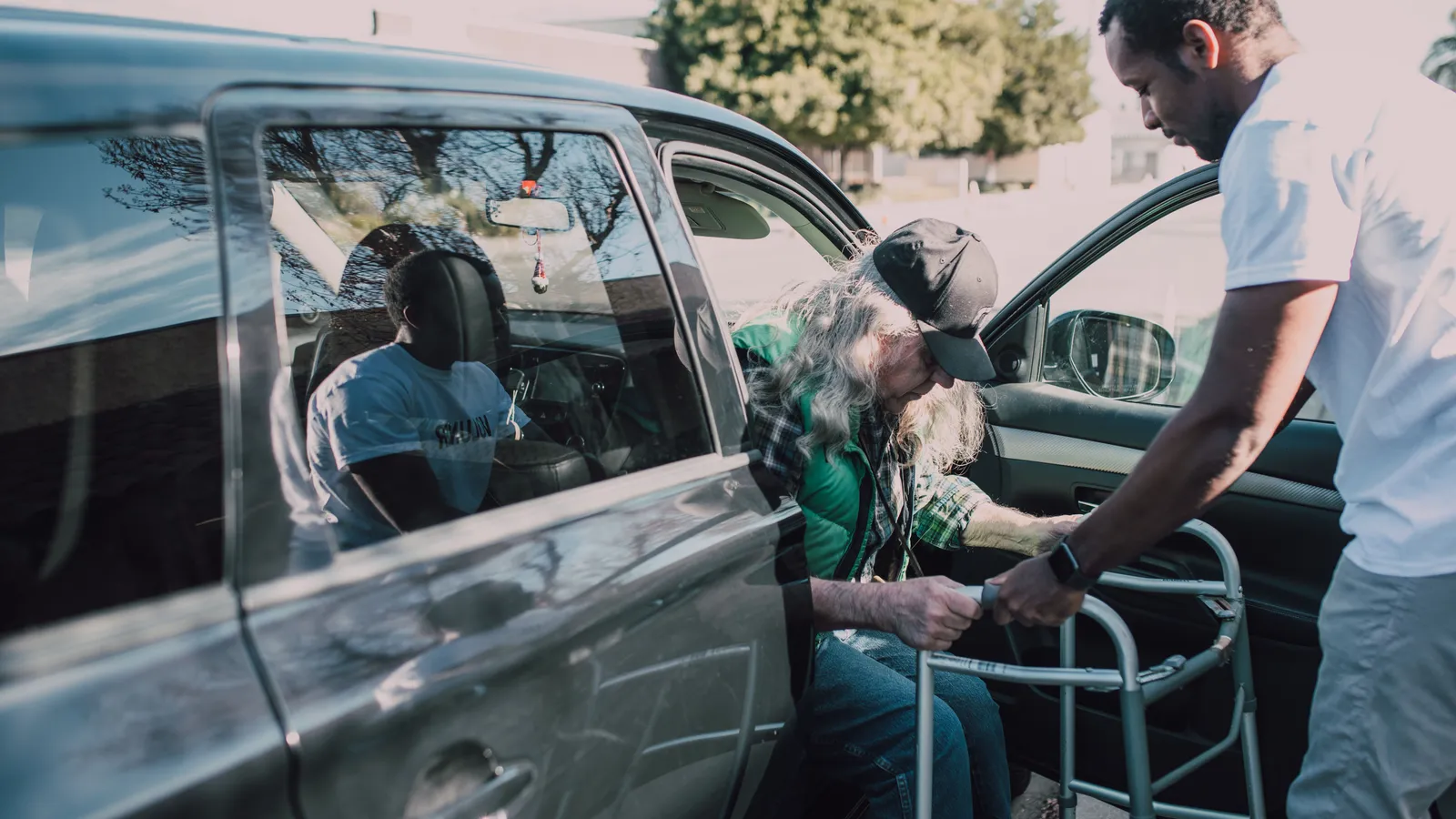
The second breaking point is mobility. Many community vans are ordinary minivans with no ramp or lift. A resident who has moved from a walker to a wheelchair may find the shuttle is no longer usable at all, even for the trips it used to cover. That transition needs wheelchair transportation with proper securement, and our page for wheelchair users sets out what that involves.
Who pays
Coverage follows the resident, not the building. A resident on Medicaid books through MAS at no cost — call 1-844-666-6270 at least 72 hours ahead and request DachiPlus by name. A resident on a Medicare Advantage plan may have a set number of one-way trips included each year, which our page on Medicare Advantage transportation explains how to check. Long-term care insurance sometimes covers transport as part of the benefit. Everything else is private pay, and for a predictable weekly run that is often the simplest arrangement.
What a facility contract changes
Communities that arrange transport frequently tend to move from ad-hoc bookings to a standing account. Staff book on a resident's behalf, invoicing is consolidated rather than collected trip by trip, and recurring runs are locked in so nobody re-arranges them each week. For a building in Garden City or anywhere across Suffolk County sending residents to the same dialysis centre repeatedly, that is materially less administrative work. Our assisted living partner programme covers how those accounts are set up.
Practical things that make the trip work
Tell the provider the resident's mobility level accurately — walking, walker, wheelchair — because that decides the vehicle, and a mismatch means a missed appointment. Say if the resident has dementia, so the driver knows to expect confusion about the destination and to hand over to staff rather than leave someone at a door. Allow an escort where it helps. And ask for door-through-door rather than kerb-to-kerb: for an older resident leaving an appointment tired, the last twenty feet is the part that matters, and it is the difference our senior medical transportation is built around.
Residents with dementia need a handover, not a pickup
For a resident with cognitive decline, the risk in a medical trip is not the driving — it is the transitions at either end. A resident who is calm in the building can become disoriented in an unfamiliar vehicle, and one who was fine on the way out may not recognise the return journey. What prevents that is a proper handover: a staff member walking the resident to the vehicle rather than sending them out, telling the driver where the resident is going and roughly what to expect, and someone receiving them at the clinic door instead of leaving them at a reception desk. Communities that treat the trip as an escorted transfer rather than a taxi booking see far fewer refused appointments. Our approach for residents with dementia and memory loss is built around exactly that, and it is worth stating the resident's needs plainly when booking rather than discovering them at the kerb.
Frequently Asked Questions
Does assisted living include transportation to medical appointments?
Usually only partly. Most Long Island communities run a scheduled shuttle to nearby shopping and to a limited set of local practices on fixed days. Appointments outside that pattern — a specialist in another county, dialysis three times a week, an early-morning procedure — generally fall to the family or to an outside provider.
Who pays when the community shuttle cannot take a resident?
It depends on the resident's coverage rather than the community. Medicaid members book through MAS at no cost. Medicare Advantage plans often include a set number of one-way trips per year. Otherwise it is private pay, long-term care insurance, or in some cases a facility contract the community itself holds.
Can a family member ride along from the community?
Yes. One escort is standard on our trips, and for a resident with dementia or significant anxiety a familiar face often makes the difference between a completed appointment and a refused one. Tell us when booking so the vehicle has the seat.
Can an assisted living community set up an account for residents?
Yes. Facility contracts let staff book on a resident's behalf, consolidate billing, and lock in recurring runs such as dialysis or infusion. That removes the scramble of arranging each trip individually and gives the community one number to call.
How far ahead should a community book?
As far as possible for recurring runs — a standing arrangement is far more reliable than repeated one-off bookings. For Medicaid trips MAS requires at least 72 hours. For private-pay trips we can often accommodate same-day requests, but morning slots across Nassau and Suffolk fill first.
Sources
Transport for assisted living residents
Families: call (516) 754-7777 and we will match the vehicle to the resident's mobility needs.
Communities: ask about a standing account for recurring runs and consolidated billing.
Medicaid residents: MAS on 1-844-666-6270, request DachiPlus.